
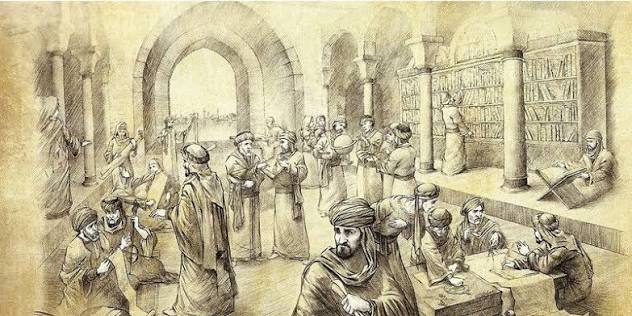
I recently found myself thinking about the Bayt al-Hikmah, the legendary House of Wisdom in 9th-century Baghdad. It wasn’t just a library; it was a grand, state-funded engine of translation and synthesis. Rulers and wealthy patrons didn’t fund the translation of Greek, Indian, and Persian texts into Arabic to secure a patent or a licensing fee. They did it because, in the ethos of the Islamic Golden Age, the pursuit of knowledge was a religious and communal trust, a waqf for the mind.
Fast forward a millennium, and we find ourselves at a remarkably similar crossroads. As CEO of JINZ.AI, I spend my days at the intersection of human talent and machine intelligence. The question that keeps me up isn't just "What can AI do?" but "Who owns what AI knows?" We are currently witnessing a high-stakes collision between the modern paradigm of Intellectual Property (IP) and a burgeoning movement of open-source AI that feels, in many ways, like a digital revival of that ancient Islamic spirit.
Is it possible that open-source AI isn't just a development model, but the catalyst for a structural shift back toward collective human understanding? And if so, does the rise of these models render our current obsession with patents and proprietary silos obsolete?
The Friction of Ownership in a Knowledge Economy
To understand where we’re going, we have to look at the weight we’re currently carrying. Our modern economy is built on the utilitarian defense of IP: we grant temporary monopolies (patents and copyrights) to incentivize creators. The logic is simple: if you can’t own it, you won’t build it.
But the data suggests this logic is fraying at the edges. Research by James Bessen highlights the staggering "patent tax" on innovation. In the late 90s alone, patent litigation costs for U.S. firms soared to over $16 billion annually, roughly 19% of their total R&D spending. Instead of protecting the "garage inventor", the system has often become a theater of strategic blocking where the cost of defending an idea exceeds the value of the idea itself.
AI intensifies this friction. Training a frontier model requires massive compute and vast datasets, often leading to the argument that only proprietary control can recoup these costs. Yet, we see the opposite happening in the open-source world. Global investment in open-source software (OSS) exceeds $8.8 trillion in demand-side economic value. Projects like Linux didn’t just survive; they became the bedrock of global infrastructure without a single proprietary license. Open-source AI models are now following this path, proving that we can build "shared intelligence" through collective investment rather than private hoarding.
Lessons from the Baghdad Commons
The Islamic Golden Age offers a profound counter-narrative to our current "ownership" obsession. During this era, knowledge was viewed through the lens of maslaha (public interest). If an invention or a translation benefitted the community, restricting it was seen as an ethical failure.
The institutional backbone of this was the waqf, or charitable endowment. Private wealth was permanently dedicated to public goods, libraries, hospitals, and schools. Imagine if we viewed the weights of a Large Language Model not as a trade secret, but as a digital waqf. By releasing models like Qwen or DeepSeek into the wild, developers are essentially creating a knowledge endowment.
This isn't just about soft-hearted altruism; it’s about epistemic justice. In a proprietary world, the Global South is a mere consumer of black-box technologies designed in Silicon Valley. But in an open-source world, a developer in Nairobi or Casablanca can take a base model and fine-tune it for a local dialect or a specific regional healthcare need. Like the scholars of the House of Wisdom who localized Indian mathematics and Greek philosophy, today’s open-source community is localizing global intelligence.
The End of the Patent Era?
Does this mean we should burn the patent office to the ground? Not quite. But AI fundamentally challenges the necessity of the old regime. When AI can generate thousands of patentable designs in a day, the very concept of "novelty" and "non-obviousness" begins to buckle.
We are moving toward a hybrid reality. Legal scholars like Lawrence Lessig argue that we should distinguish between "learning" and "copying." If an AI "learns" from a dataset, that shouldn't be a copyright event, any more than a human reading a library book is an act of theft. However, we do need new structures for provenance, knowing who trained what, and with what data.
The real innovation in the AI era won't be in the proprietary "weights" of a model, but in the services, ethics, and integrations built around those models. Just as Red Hat built a multi-billion dollar business on "free" Linux, the winners of the AI era will be those who provide trust, safety, and specialized application, not those who try to build a wall around a mathematical formula.
Scaling the New House of Wisdom
If we want to usher in a new era of collective understanding, we need to move beyond "accidental" open source and toward intentional "Digital Waqfs." This means:
- Public Infrastructure: Governments should fund the training of base models as public goods, treated with the same necessity as roads or power grids.
- Ethical Licensing: We need licenses that protect against malicious use while mandating that improvements to the "commons" are shared back.
- Transparency as Default: The "black box" is the enemy of collective knowledge. Open source allows for the auditing and scrutiny necessary to ensure AI reflects our human values, not just corporate incentives.
We are at a point where the cost of secrecy is beginning to outweigh the benefits of protection. By embracing open-source AI, we aren't just choosing a different software license; we are choosing a different philosophy of human progress.
The House of Wisdom fell in 1258, but its legacy was the idea that knowledge belongs to whoever can use it for the good of the world. As we build the most powerful cognitive tools in history, we have a choice: do we build a fortress, or do we build a library? I, for one, hope we choose the library. Through the collective lens of open-source AI, we might finally realize that the most valuable thing about intelligence isn't that it can be owned, but that it can be shared.